
This is How Supermassive Black Holes Feed Themselves
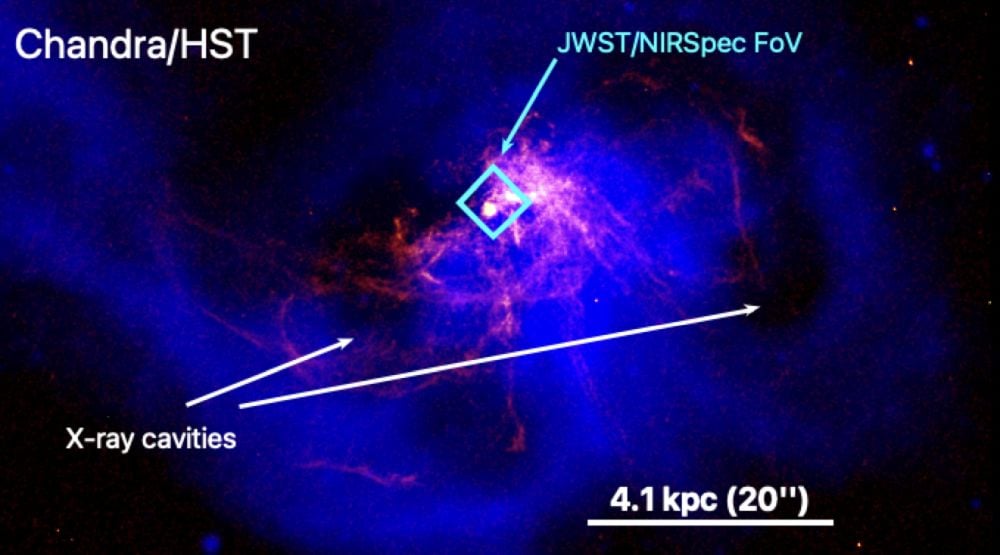
New research using the James Webb Space Telescope has identified a rotating circumnuclear disk around the supermassive black hole in NGC 4696, part of the Centaurus cluster, which is connected to a vast network of gaseous filaments. This discovery provides insight into how supermassive black holes accrete material from their surroundings. The detailed observations reveal a link between large-scale gas flows and the smaller-scale processes near the black hole, offering a clearer understanding of how these systems sustain themselves. The study highlights the importance of the Centaurus cluster in testing models of black hole feedback and galaxy evolution.
Astronomers used the James Webb Space Telescope to study a swirling gas pattern near a supermassive black hole in the galaxy NGC 4696, revealing how gas flows feed the black hole.
This discovery helps explain how supermassive black holes grow and influence their galaxies, offering new insights into the connection between gas movement and black hole activity.
The research highlights the power of advanced telescopes to uncover cosmic processes, advancing our understanding of the universe in a way that inspires curiosity and scientific progress.
upbeatBytes summarizes in its own words and links to the original publisher — it doesn't host the article.