
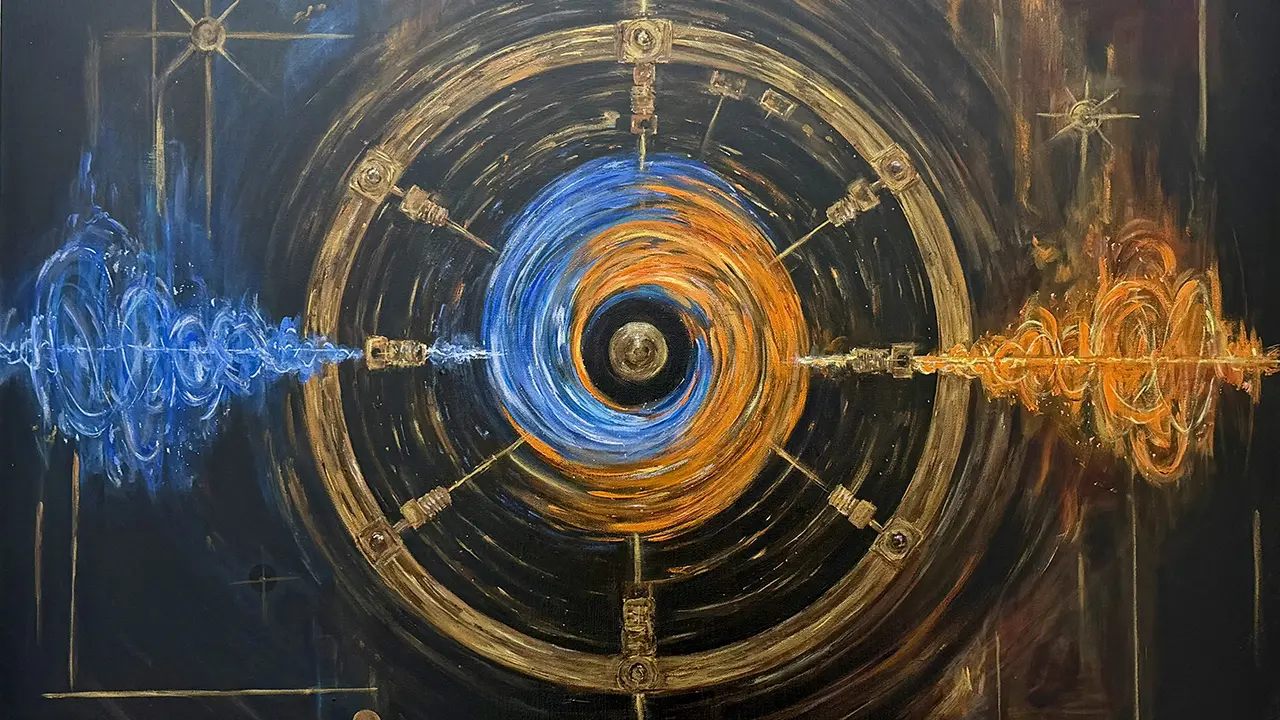
Researchers Prove Black Theory in a Laboratory Setting
Researchers at CUNY-ASRC have successfully demonstrated a theoretical concept proposed by Roger Penrose and later expanded by Yakov Zeldovich, showing that energy can be extracted from a rotating black hole through wave interactions. Using a radio-frequency device that mimics ultra-fast rotation, they achieved synthetic motion that allowed electromagnetic waves to extract and amplify energy, validating a long-standing prediction in physics. The experiment provides a new tool for studying extreme rotational dynamics and has potential applications in astrophysics, communications, and quantum science. This breakthrough bridges theoretical predictions with practical experimentation, opening new avenues for research and technology development.
Scientists have successfully tested a theory about extracting energy from black holes in a lab using a device that mimics ultra-fast rotation.
This breakthrough could advance understanding of extreme physics and has potential applications in communications, optics, and quantum science.
The experiment shows how theoretical ideas can be tested in the real world, offering new tools for scientific discovery and practical innovation.
upbeatBytes summarizes in its own words and links to the original publisher — it doesn't host the article.